Bringing the Enchantment of The Magic Flute to Powell Hall
By Iain Shaw
What’s an opera without the grand sets and costumes? For Music Director Stéphane Denève, operatic concerts are a powerful strand of the St. Louis Symphony Orchestra’s programming, one that gives local audiences the chance to hear the world’s finest vocalists alongside the exceptional musicians of the SLSO, assisted by the newly improved acoustics of Powell Hall.
The SLSO’s upcoming staging of Wolfgang Amadeus Mozart’s The Magic Flute (February 20 and 22) isn’t intended to replicate an opera house experience. Less emphasis on set design, costumes, and movement creates space to focus on the music.
“I want the singers to have the possibility of concentrating more on their musical interpretation, and I want people to have a chance to hear the singers in front of the orchestra and to focus on listening to them,” Denève said.
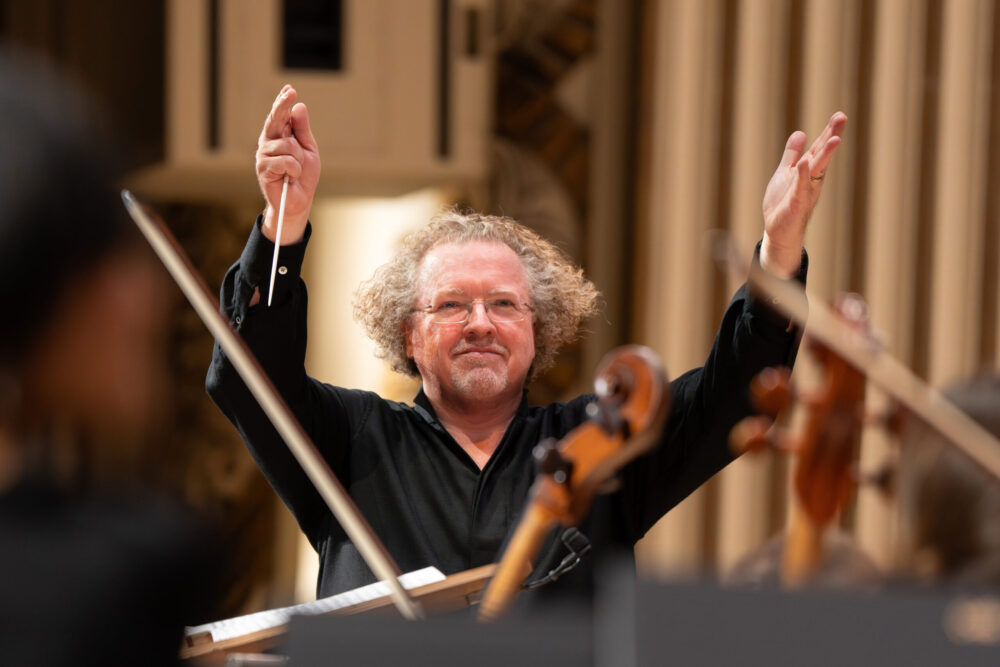
Opera has played a profound role in Denève’s career, and Mozart’s operas have a special place in his heart. The SLSO’s production of The Magic Flute is based on Cori Ellison’s adaptation, which Denève described as a “beautiful” retelling of the story from the perspective of the heroine, Pamina (sung by Mei Gui Zhang), as she undergoes various trials with Prince Tamino to achieve enlightenment and overcome darkness. The singing will be in the original German, but spoken text will be in English, and English supertitles will also be provided.
A cast including world-renowned singers including soprano Rainelle Krause and tenor Ben Bliss is an exciting prospect, and the St. Louis Symphony Chorus will also play a starring role, alongside the musicians of the SLSO. With Powell Hall sounding better than ever, Denève said guests are in for a treat.
“We’ll hear The Magic Flute acoustically in a way that is so luxurious,” he said. “The voices of the choir, the voices of the singers, are magically, beautifully amplified.”
Mozart’s score is so vivid and suggestive, Denève added, that the music does a lot of the work of scene-setting and storytelling.

“When Tamino arrives on stage and is pursued by an evil serpent, of course you can have props on stage to show it,” he said. “But it’s also there in the music. If we do our job well, people just have to imagine the scene—and it could be even better in the imagination.”
On the surface, The Magic Flute is a simple fairy tale of good and evil, princes and princesses, and the eponymous woodwind instrument with the magical power to protect and enchant. However, Denève said the opera’s philosophical and metaphorical depth is a worthy complement to Mozart’s stunning score.
“There are so many layers of meaning, so much to interpret,” he said. “It’s about light versus darkness, of course, and superstition against reason.”
Within those dualities, there are further nuances and complexities.
“It’s not as simple as the Queen of the Night being the dark force and [the high priest] Sarastro the light force,” Denève said.
Similarly, Denève believes the opera makes a salient point about equality.
“Tamino and Pamina only succeed as a couple equally,” he said. “I love that it actually promotes the idea that men and women should have equal power.”

The opera’s symbols and allusions—many relating to Freemasonry, a passion of Mozart’s latter years—are plentiful and well-documented: the repetition of the number three, the competing forces of dark and light, and the trials Tamino and Pamina endure are just a few examples. But in studying the score ahead of the SLSO’s concerts, Denève said he discovered details buried in the music that he has never considered before.
“The very first three chords summarize not only the whole piece, but also our whole lives,” he said.
The initial optimism of an E-flat major is followed by a C minor, which Denève said he associates with “struggle, sadness, and the dark parts of life.” The sequence resolves with an inverted E-flat major, with G as the bass note. In this sound, Denève hears a perspective that comes with wisdom and experience: more doubtful and questioning, yet also lighter and more hopeful, than the opening chord.
Denève also believes anyone seeing The Magic Flute for the first time will recognize a universality to its themes and characters. You might know a Papageno, a Tamino, or a Sarastro in your own life—or identify something of yourself in them.
“It speaks to a lot of archetypes,” he said. “This opera confronts you with who you are. It seems I’m getting an opportunity to reassess where I am in life, what I believe in, and where I stand. It’s a philosophical journey.”
For all its layers of meaning, Denève said The Magic Flute’s most important message is right there in the title.
“It’s the magical power of music, the transformative power of music, the virtuous power of music,” he said. “I love that music can tame wild animals, that music can have a transformative power that that makes people better, and that we can overcome chaos and destruction with harmony and the beauty of music.”
Iain Shaw is the SLSO’s Content Manager.