Handel’s masterpiece returns to Powell Hall
By Yvonne Frindle, based on an interview by Iain Shaw
G.F. Handel’s Messiah might seem like the perennial potboiler—utterly familiar—but talk to conductor Nicholas McGegan and it becomes clear there’s nothing about this work that can be taken for granted.
“Every performance I give is different,” he says, “because the soloists are different and my interpretation is heavily based on them.”
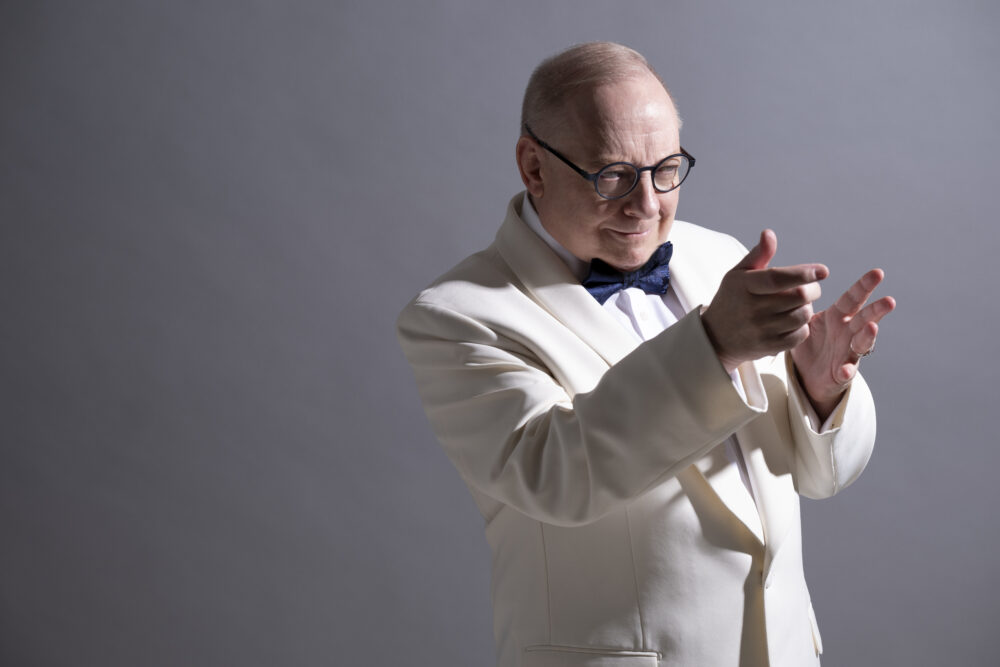
McGegan has described opera as “one of the most delightful challenges there is,” and his dramatic instincts come to the fore in a work like Messiah. He places the text front and center, he explains, giving the work a strong dramatic flow rather than treating it as simply a sequence of separate movements. “Handel was a dramatist of genius and I like to bring this out.”
Messiah is a sacred oratorio—music with a religious theme—but McGegan finds it very moving on a human level. “The journey through the depths of pathos in the second part through to the glories of the final Amen really does stir the soul.”
McGegan’s reputation stems in large part from his many years as Music Director of the Philharmonia Baroque Orchestra, leading performances on period instruments that were not only historically informed and stylish but deeply engaging, and fun. And he brings his joyful approach to “modern” symphony orchestras such as the SLSO. He regards orchestras as “social beings” and, as with different teams of soloists, he shapes his interpretations to fit the particular players. In his view, a conductor doesn’t have the “right collar” to preach, and while historical performance practice can be fascinating—an easy obsession to fall into—his focus is always on giving a good performance rather than “correctness.”
That said, you may notice in this performance that McGegan’s tempos are faster than you might remember from past decades, and the orchestra and choir are a little smaller than the “mega-Messiahs” once prevalent in the 20th century. These are choices that, he hopes, will make the performance “seem less stodgy.”
Messiah might be easy to listen to but, he says, it’s not easy to sing or to play. “The chorus parts require great flexibility of voice, the soloists have to have good coloratura, and the violin parts are virtuoso too.”
Adding to the challenge is Handel’s decision to keep rewriting parts of Messiah throughout his life. “He changed the voices in the solos according to who was the star in each run of performances,” McGegan explains. “Choosing which version to use is always a challenge. Personally, I feel that if one can put the text across clearly to the audience one has already achieved a great deal.”
McGegan’s relationship with Messiah runs in tandem with his longstanding connection to the SLSO. It was in St. Louis, in 1986, that he first conducted the oratorio, and he carries fond memories of those performances from nearly 40 years ago. “The divine Lorraine Hunt was the soprano and she sang gloriously; Tom Peck was in charge of the chorus, who were wonderful.” One amusing moment in a later performance, he recalls, “was when an audience member blew their nose really loudly in the grand silence just before the end. All of us got the giggles and we only just managed to finish the piece!”
The last time McGegan conducted the SLSO was in 2023, so this week will be his first time working in the newly renovated Powell Hall, and the new acoustic may further influence tempo and other interpretative choices. Perennial or not, this Messiah is guaranteed to feel fresh, dramatic, and joyous.
Iain Shaw is the SLSO’s Content Manager.