Orchestra
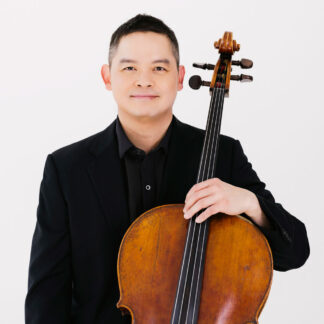
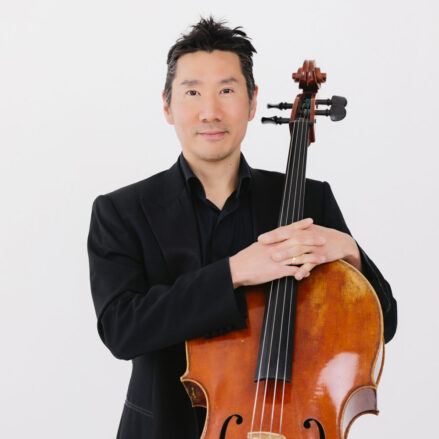
Daniel Lee
“Lee is the kind of phenomenon who doesn’t come around every day—or every decade, for that matter.” — The Seattle Times
A native of Seattle, Daniel Lee began playing the cello at age six, studying with Richard Aaron. At 11, he entered the Curtis Institute of Music and became the youngest protégé of the legendary Mstislav Rostropovich, the cellist for whom Shostakovich, Prokofiev, and Britten composed their greatest cello works. At Curtis, Lee also studied with Orlando Cole, William Pleeth, and Peter Wiley, later earning an Artist Diploma from the New England Conservatory under Paul Katz of the Cleveland Quartet. In 1994, at the age of 14, he signed an exclusive recording contract with Decca Records, releasing acclaimed recordings of Schubert’s Arpeggione Sonata and the Brahms cello sonatas. In 2001, at the age of 21, he received the prestigious Avery Fisher Career Grant—just one of many awards and competitions won during his career. Lee was also named one of the St. Louis Business Journal’s “40 under 40.”
Lee has appeared as soloist with the Baltimore Symphony, Cincinnati Symphony, Cleveland Orchestra, New Jersey Symphony, Philadelphia Orchestra, Seattle Symphony, and the St. Louis Symphony Orchestra, where he has served as Principal Cello since 2005. Following his New York debut at 18, performing Shostakovich’s Cello Concerto No. 1, the work Rostropovich himself premiered, The New York Times declared: “His performance was assertive and commanding from the opening bars… his sound was powerful and rich, his palette broad enough to accommodate both the soulfulness of the Cadenza and the tartness of the closing Allegro con moto.”
An active recitalist, Lee has performed at the Kimmel Center in Philadelphia, Jordan Hall in Boston, the Herbst Theater in San Francisco, and on tours throughout Japan and Korea. The San Francisco Chronicle wrote: “There are gifted young musicians, who play their instruments with insight and technical skill. And then there are phenomena like Daniel Lee. His command of the instrument is staggering, from an extravagantly rich, burnished bottom range to top notes that sing out with remarkable clarity and precision.” After his Seattle recital at Benaroya Hall, The Seattle Times observed: “Already enormously assured, technically brilliant and artistically mature, this is a cellist who is beyond the category of ‘promising.’ He’s a young artist who unquestionably has a major career ahead, and last night’s audience will be able to say they ‘heard him when.'”
With the SLSO, Lee’s concerto appearances have included Strauss’s Don Quixote, Esa-Pekka Salonen’s Mania, Tchaikovsky’s Variations on a Rococo Theme conducted by Bernard Labadie, Dvořák’s Cello Concerto conducted by Peter Oundjian, and Haydn’s Cello Concerto in D major conducted by Jun Märkl. He performed the St. Louis premiere of Osvaldo Golijov’s Azul with David Robertson conducting. Following his performance of Elgar’s Cello Concerto, the St. Louis Post-Dispatch proclaimed that Lee “made the concerto his own in a beautiful and deeply touching display of interpretive and musical virtuosity.” His complete performance of the Dvořák was featured in a one-hour documentary broadcast on PBS St. Louis and hailed as a “triumphant performance.”
Lee made his New York recital debut at Merkin Hall with a program highlighted by Zoltán Kodály’s Sonata for Unaccompanied Cello. The St. Louis Post-Dispatch called it “astounding… one that left the audience almost as simultaneously exhilarated and wrung out as the cellist himself at its end. Watch Danny Lee play, and you’d swear that he’s become one with his instrument—and with the music.”
Other career highlights include the U.S. premiere of James MacMillan’s Kiss on Wood with the St. Paul Chamber Orchestra and a performance of Nomos Alpha by Iannis Xenakis at the Pulitzer Foundation for the Arts. His recording of Tchaikovsky’s Rococo Variations with the Czech Philharmonic was released on Sony Classical, coinciding with a concert at Seoul Arts Center.
Lee resides in St. Louis with his wife, SLSO cellist Elizabeth Chung, and their two daughters. Deeply committed to the region’s cultural vitality and connected community life, he actively stewards a historic 1920s architectural landmark in the Wydown-Skinker neighborhood, with a focus on preserving the city’s heritage and strengthening the medical, academic, and broader civic fabric of the St. Louis region.