Assistant Conductor Samuel Hollister on the Magic of Composer Joe Hisaishi’s Music
Music can transport listeners to distant places, imagined worlds, and personal memories—and few composers harness that power as vividly as Joe Hisaishi. On October 8 and 10, the St. Louis Symphony Orchestra performs a special program that pairs the music of Hisaishi, celebrated for his collaborations with filmmaker Hayao Miyazaki and Studio Ghibli, with evocative works by Felix Mendelssohn, Kaija Saariaho, and Arnold Bax. It’s a program that evokes a sense of magic and wonder.
The October 8 concert will take place at Powell Hall while the October 10 concert will be held at the J. Scheidegger Center for the Arts at Lindenwood University in St. Charles.
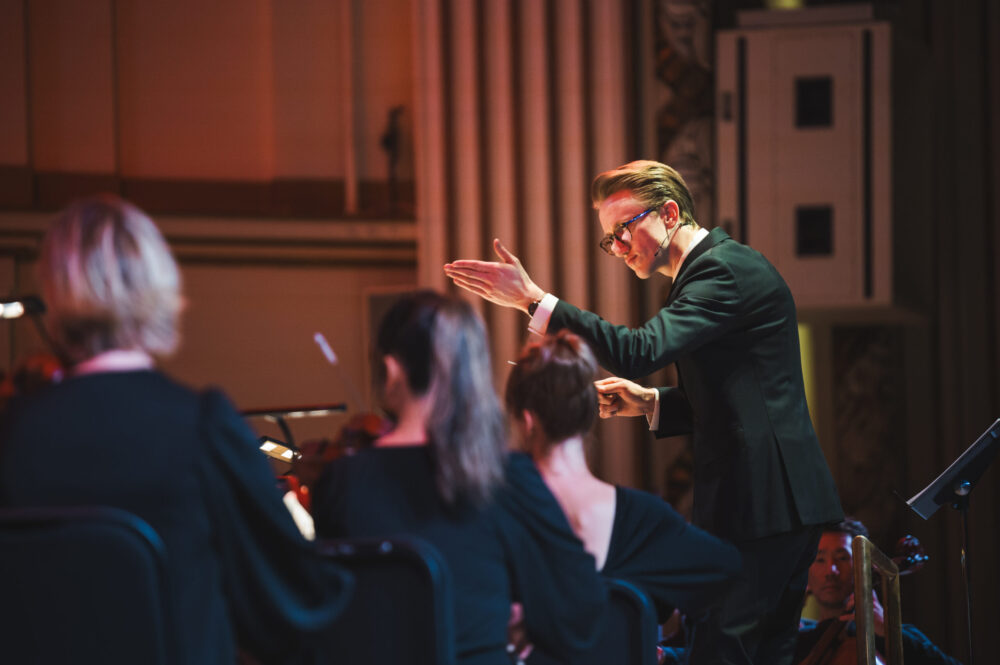
SLSO Assistant Conductor Samuel Hollister leads this program that ends with Hisaishi’s music to the beloved films Spirited Away and Howl’s Moving Castle. Hollister, a Studio Ghibli fan himself, discussed the musical threads connecting these distinctive soundscapes, the ways film music enriches and advances storytelling, and what makes Hisaishi’s scores so compelling in the concert hall.
Get tickets to Symphonic Dreamscapes: Hisaishi and Beyond here.
This interview was edited for length and clarity.
This program travels from Felix Mendelssohn’s enchanted forest to Kaija Saariaho’s winter sky, Arnold Bax’s legendary coastline and Joe Hisaishi’s cinematic worlds. What musical thread connects these very different landscapes?
Each of the program’s pieces is connected by the idea of imagination. The Mendelssohn conjures the idea of an imaginary enchanted forest immediately, with the orchestra sounding like moonlight, fairies, mischief. The Saariaho considers the mythological hunter Orion, who is placed by Zeus in the sky as the constellation we know after his death. The Bax piece is incredibly imaginative—he saw the ruins of this English castle called Tintagel on the rugged Cornish coast, and through this piece, he imagines what a glorious place it must have been in its time. Both Hisaishi films, Spirited Away and Howl’s Moving Castle, similarly explore ideas of imagination and fantasy, and Hisaishi’s soundtracks capture that spirit of wonder in much the same way that the first three pieces do.
When Hisaishi’s music is performed without the accompanying film, what qualities become more apparent to the listener?
I think we begin to appreciate how much his music does to define the world of the Studio Ghibli films that we adore so much. If you watch a Ghibli film with the music muted, it’s nothing at all compared to the experience with Hisaishi’s music. When we perform these suites alone, we also really get the chance to notice how beautifully Hisaishi orchestrates.
Where do you hear Hisaishi drawing upon the classical symphonic tradition, and where does his musical voice feel unmistakably his own?
Hisaishi definitely has a pantheon of composers from Dvořák to Brahms to Stravinsky in his ear when he chooses instruments, textures, and layering. But one thing is his signature touch and his alone, and that’s his sense of melody. You can hear a Hisaishi melody and know, without a moment’s hesitation, that he wrote it.
Bax’s Tintagel combines a real landscape, Arthurian legend, and private emotion. Does that layering of place, myth, and personal feeling anticipate anything in Hisaishi’s music?
Absolutely! Speaking of melodies, Bax has a deeply moving melody of his own about a minute into Tintagel which somehow seems to evoke the splendor of the castle as it must have stood centuries ago, the isolation of the castle in an unforgiving and rugged coastal setting, and the tender sensibility of some main character. It’s music that conveys so much all at once. Hisaishi uses all the same strategies to create music that accomplishes just as much. Just thinking of One Summer’s Day, the melody that defines Spirited Away, I think of the very same themes layered into one natural melody: splendor, loneliness, and tenderness.
Do you think the traditional distinction between “concert music” and “film music” remains useful when discussing a composer like Hisaishi?
Film music is concert music, and concert music is film music. And actually, it was that very thought that led to this program existing. The fact is that film composers like Hisaishi and composers of concert music all use the exact same techniques for the exact same purpose.
How does Hisaishi’s collaboration with Hayao Miyazaki compare with other defining composer-director partnerships in cinema?
There are few collaborations truly like the Miyazaki/Hisaishi collaboration, but I do think of Steven Spielberg and John Williams. There’s a depth of mutual understanding that allows the films and soundtracks to merge seamlessly. I think about what Spielberg once said about Williams—”without John Williams, bikes don’t really fly. Dinosaurs do not roam the earth. We do not wonder, we do not weep, we do not believe.” The visual storytelling and art of the Ghibli films is iconic and breathtaking, but Hisaishi’s music is why we are transformed.
What would you say to someone attending primarily because they love Studio Ghibli but are uncertain whether a symphonic concert is for them?
Oh, I love Studio Ghibli too, and I can assure you, a symphonic concert is most certainly for you! We put this program together explicitly because there really is no difference between loving Hisaishi’s musical storytelling and loving Bax’s, or Saariaho’s, or Mendelssohn’s. Even if you haven’t heard the other pieces on the program, you’ll see a movie of your own making in your mind just as vividly.
Get tickets to Symphonic Dreamscapes: Hisaishi and Beyond here.
Compiled by Eric Dundon.