John Williams and Kevin Puts (March 20 & 22, 2026)
Program
March 20 & 22, 2026
- Stéphane Denève, conductor
- Time for Three
- Ranaan Meyer, double bass, vocals
- Nicolas Kendall, violin, vocals
- Charles Yang, violin, vocals
John Adams (b. 1947)
- Short Ride in a Fast Machine
Kevin Puts (b. 1972)
- Contact (Triple Concerto for Two Violins, Bass, and Orchestra)
- The Call
- Codes (Scherzo)
- Contact
- Convivium
Time for Three
Ranaan Meyer, double bass, vocals
Nicolas Kendall, violin, vocals
Charles Yang, violin, vocals
Intermission
John Williams (1932)
- Excerpts from Close Encounters of the Third Kind
- “Adventures on Earth” from E.T. the Extra-Terrestrial
- Selections from Star Wars Suite
- Main Title
- Princess Leia’s Theme
- The Imperial March (Darth Vader’s Theme)
A Cosmic Journey
None of the music featured in today’s concert is more than 50 years old. It’s the kind of program that taps into childhood experiences and powerful memories, and that’s especially the case for Kevin Puts. When Star Wars and Close Encounters of the Third Kind came out, Puts was five years old; when E.T. was released he was ten. As a boy, he couldn’t imagine a film without a John Williams score. The final sequence of E.T., in particular, left him on the verge of tears. It captured the tenderness, the resignation, and the finality of goodbye in an almost operatic way, and, says Puts, this “indescribably beautiful” music has the same effect on him today.
Short Ride in a Fast Machine, John Adams’ orchestral fanfare from the 1980s, taps into a very different, but equally powerful, emotion. His laconic response to a question about the title sums it up: “You know how it is when someone asks you to ride in a terrific sports car, and then you wish you hadn’t?”
And so today’s cosmic journey begins on earth with a white-knuckle ride in a big, shiny orchestral “machine” powered by the relentless pulse of a woodblock. Our ears are turned to space with Contact, the concerto Puts wrote to showcase the gifts of the multitalented Time for Three. You’ll hear their voices first, in the bittersweet harmonies of a signature theme that is a direct descendent of the “communications motif” in Close Encounters. The concerto’s title was in part inspired by the deeply human need for contact during the COVID-19 pandemic, but Puts was also thinking of music as a message, “a call to intelligent life across the vast distances containing clues … to our very nature as Earth people.” Listen closely and you’ll hear suggestions of radio transmissions, wave signals, and the moment of contact itself—no words, only music as a means of connection.
Ultimately, it’s John Williams who takes us into the cosmos: his rich symphonic language bearing us aloft to a galaxy far, far away.
Short Ride in a Fast Machine
John Adams
Born 1947, Worcester, Massachusetts
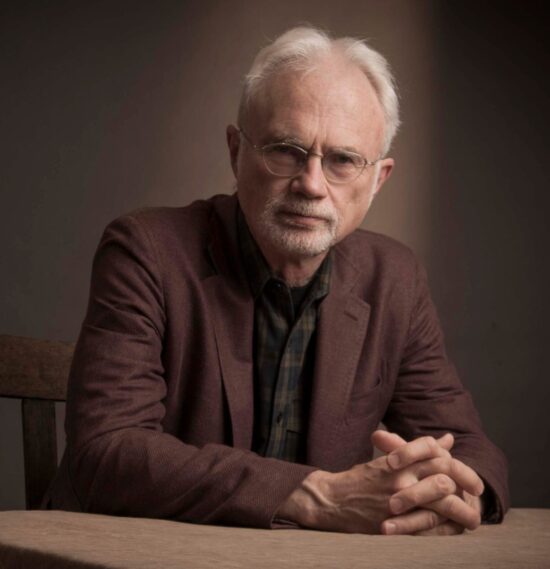
John Adams’ music is littered with gadgets, engines, devices. There are the player pianos in Century Rolls, the oil tankers of Harmonielehre, the record player in The Chairman Dances, the atom bomb at the end of Dr. Atomic. His music exists at the juncture between old and new, between trembling organic beauty and mechanical precision.
One day in the 1980s, a friend took Adams for a drive in an Italian sports car. He found the experience terrifying, and when he came to write a fanfare on commission from the Pittsburgh Symphony Orchestra, he had still not recovered. Short Ride became an evocation of that thrilling, white-knuckle experience.
The composer writes:
The piece starts with the knocking of a woodblock, which creates a sort of rhythmic gauntlet through which the orchestra has to pass. We hear fanfare figures in the brass, but in a kind of rat-a-tat, tattoo staccato form, which typifies most of the activity of this very fast orchestral fanfare.
Part of the fun is making these large instruments—the tuba and double basses, and contrabassoon—move. They have to boogie through this very resolute and inflexible pulse set up by the woodblock.
It’s only at the very end that the orchestra feels free—as if it’s the third stage of a rocket that’s finally broken loose of earth’s gravity and is allowed to float. It’s at that moment that we hear the triumphant “real” fanfare music in the trumpets and horns.
Tim Munro © 2020
About the composer
John Adams occupies a unique position in American music. One of the most performed of all living composers, his works stand out for their depth of expression, brilliance of sound, and profoundly humanist themes. His work played a decisive role in turning the tide of contemporary musical aesthetics away from academic modernism and toward a more expansive, expressive language.
His music often features the trademark repetition, harmonic language, and energy of minimalism. But his works vary greatly, embracing the cyclic Shaker Loops (1978), showpieces such as Short Ride in a Fast Machine, and the opera Nixon in China (1987). Adams’ The Gospel According to the Other Mary (2012) was described by critic Alex Ross as a work of daring from a popular, celebrated artist willing to set aside familiar devices and step into the unknown.
| First performance | June 13, 1986, Michael Tilson Thomas conducting the Pittsburgh Symphony Orchestra |
| First SLSO performance | November 1, 1996, Marin Alsop conducting |
| Most recent SLSO performance | March 7, 2020, Stéphane Denève conducting |
| Instrumentation | 2 flutes, 2 piccolos, 2 oboes, English horn, 2 clarinets, 3 bassoons, contrabassoon, 4 horns, 4 trumpets, 3 trombones, tuba, timpani, percussion, 2 synthesizers, strings |
| Approximate duration | 5 minutes |
Contact – Triple Concerto
Kevin Puts
Born 1972, St. Louis
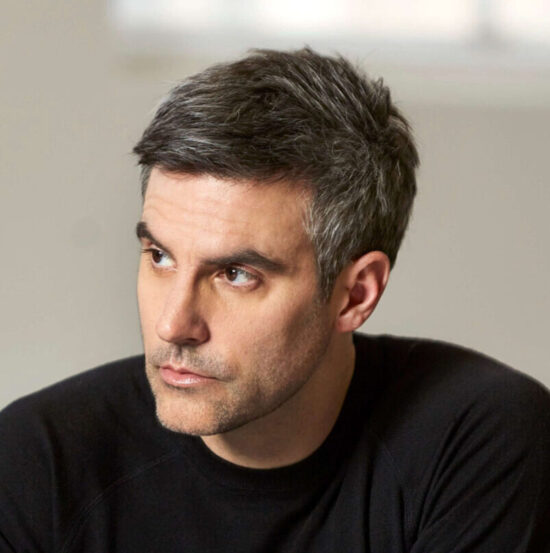
The composer writes:
In April 2017, I heard Time for Three for the first time at Joe’s Pub in New York City. The group had reached out about the possibility of my writing them a concerto, and after hearing them play, sing, improvise, and perform their own music that evening I felt both elated—by their infectious energy and joy—and also rather daunted by the thought. It seemed our musical tastes were so similar that I suggested to them, not at all facetiously, “Maybe you ought to write your own concerto!” I simply couldn’t imagine conceiving any music they couldn’t improvise themselves.
One of the tunes the trio performed that night was an original, Vertigo, in which all three members both play their instruments and sing. I wondered about the possibility of beginning the concerto with the trio singing a wordless refrain, a cappella. I wrote a chord progression which unfolds from a single note and progresses through simple, suspended harmonies. Orchestral winds respond with the same music while the trio adds decorative, improvisatory gestures. This idea, first heard in a reflective manner, grows considerably until the orchestral brass deliver a most emphatic version of it. This first movement (The Call) ends with the same sense of questioning with which it began.
Threatening unison stabs, played by the entire orchestra, break the mood startlingly and impel the soloists who drive forward with syncopated rhythms and virtuoso flurries of arpeggios. The energy in this second movement (Codes) is unrelenting.
In yet another contrast, the orchestral music that opens the third movement (Contact) is cold and stark. I imagined an abandoned vessel floating inert in the recesses of space. The soloists interrupt with a gently rolling meditation, eventually inviting a solo oboe and a solo clarinet to join in lyrical counterpoint high above. The soloists then recall the stark opening of the movement, rendering its rhythms into an unaccompanied phrase of tenderness and longing.
The search for a silver lining amid the COVID-19 pandemic was a challenge. But the cancellation of the initial performances of Contact scheduled for the summer of 2020 allowed us to continue working together on the concerto long after I finished it. Though my original title was simply “Triple Concerto,” we all agreed there was something more than abstract musical expression going on, that there was a story being told.
Could the refrain at the opening of the concerto be a message sent into space, a call to intelligent life across the vast distances, containing clues to our DNA, to our very nature as Earth people? Could the Morse code-like rhythms of the scherzo suggest radio transmissions, wave signals, etc.? And might the third movement (originally called simply “Ballad”) represent the moment of contact itself? (The climax of the film adaptation of Carl Sagan’s Contact—in which Ellie [Jodie Foster], en route via a wormhole to an alien civilization, witnesses a radiant cosmic event and tearfully breathes, “No words … they should have sent a poet … no words …”—was in my mind during these discussions.)
Still in search of a finale, I was serendipitously introduced to Gankino horo (Ganka’s Dance), a traditional Bulgarian melody, blazingly performed by at least 12 young cellists in unison at my son’s studio cello recital. At home, I began playing it on the piano and gradually my own compositional voice crept in. I was reminded of Béla Bartók’s haunting Romanian Folk Dances—fusing the composer’s musical sensibilities with age-old folk melodies. And so I set about composing a sort of fantasy on this tune, its asymmetric rhythmic qualities a fitting counterbalance to the previous three movements.
The word “contact” gained new resonance during those years of isolation. It is my hope that this concerto might be heard as an expression of yearning for this fundamental human need. I am deeply grateful to Time for Three for their belief in my work and for the tireless collaborative spirit which allowed us to develop this showcase for their immense talents.
Abridged from a note by Kevin Puts © 2022
About the composer
Kevin Puts is the SLSO’s 2025/26 Composer in Residence. Earlier this season, the SLSO commission House of Tomorrow received its premiere with Joyce DiDonato. In the coming weeks, the SLSO will perform more music by Puts: Concerto for Orchestra, Virelai (after Guillaume de Machaut), and Home (at the Contemporary Art Museum), and the Youth Orchestra will perform his Hymn to the Sun.
His music has also been commissioned and performed by leading American institutions and he has collaborated with other leading soloists such as Renée Fleming and Joshua Bell. In 2022, his fourth opera, The Hours, received a triumphant stage premiere at the Metropolitan Opera and an immediate revival in 2024.
His accolades include the 2012 Pulitzer Prize for his opera Silent Night, the 2023 Grammy Award for Best Contemporary Classical Composition (Contact), and Musical America’s Composer of the Year in 2024. Puts teaches at the Peabody Institute in Baltimore and is director of the Minnesota Orchestra Composer’s Institute; he was Distinguished Visiting Composer at the Juilliard School in 2024–25.
| First performance | March 26, 2022, by the Florida Orchestra and Time for Three, conducted by Daniel Black |
| First SLSO performances | These concerts |
| Instrumentation | amplified string trio (2 violins, double bass); 3 flutes (one doubling piccolo), 3 oboes (one doubling English horn), 3 clarinets (one doubling bass clarinet), 3 bassoons, contrabassoon, 4 horns, 3 trumpets, 3 trombones, tuba, timpani, percussion, piano, strings |
| Approximate duration | 30 minutes |
Music for the Stars
John Williams
Born 1932, Flushing, New York
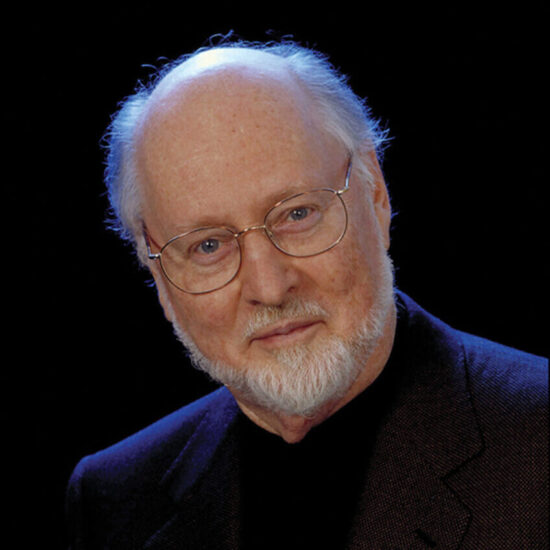
John Williams is credited with restoring symphonic sound to the movies in the 1970s—putting the orchestra back into cinema—and for nearly 50 years, orchestras have been returning the compliment by bringing his film music into the concert hall. Williams spearheaded the symphonic soundtrack revival with The Poseidon Adventure in 1972. Jaws followed in 1975. Two years later, he composed Close Encounters of the Third Kind and the score that made his name, Star Wars.
Close Encounters of the Third Kind
Ironically, today’s Excerpts from Close Encounters begins in precisely the sound world that Williams was displacing: the electronica of 1960s sci-fi. In the opening, Williams shows how violins playing clusters of notes very quietly at the top of their range can “do” electronics even better than a computer. But the eerie, dissonant shimmering gives way to the warm, string sound of Romanticism. Through music, Williams conveys the tension between the anxiety and allure of an alien visitation.
Much of a film composer’s work is spent responding to footage. But before shooting on Close Encounters of the Third Kind could begin, director Steven Spielberg needed the five-note theme that would function as the aliens’ “communication motif.” After trying more than 250 combinations, Williams arrived at the one that’s now emblematic of Close Encounters.
This motif offers a rare instance of music theory in popular cinema. Reaching out to the alien scout ships, a scientist calls for a synthesizer sequence: “Start with the tone. Up a full tone. Down a major third. Now drop an octave. Up a perfect fifth.” Remarkably, these peaceful, intelligent aliens catch on to the Curwen–Kodály hand signs for these same notes: Re Mi Do Do So!
E.T. the Extra-Terrestrial
By the time of E.T. the Extra-Terrestrial (1982), the Williams–Spielberg partnership was firmly cemented and another much-loved score emerged for this enchanting fantasy about a stranded alien botanist. Adventures on Earth is a tiny tone-poem drawn from the music of the final sequences as E.T. escapes from his adult captors and makes an emotional departure— the “Flying Music” literally soars in uplifting orchestral sound. This film represented an even more significant departure from the convention of “film first, music later.” Just as Eisenstein had collaborated with Prokofiev for the score of Alexander Nevsky in 1938, Spielberg cut his film to fit Williams’ music. A vote of confidence in the storytelling power of music.
Star Wars
Williams recognized that Star Wars was at heart a work of romantic storytelling. Seeking an emotionally familiar musical language, Williams drew on 19th-century operatic idioms, in particular Richard Wagner’s use of leading motifs for individual characters and concepts.
The visually stunning opening with its signature “text crawl” called for a Main Title that would, as Williams says, “smack you right in the eye.” The brass give the fanfare an idealistic but military flare. This contrasts with a lyrical and romantic, but also adventurous, second theme.
The theme for Princess Leia conveys a protagonist who is beautiful, vulnerable, and courageous, and a solo horn brings nobility as well as lyricism. But this theme is also heard when Obi-Wan Kenobi dies at the hands of Darth Vader—with Leia a mere onlooker—suggesting, writes Rod Webb, that it also represents the ideal of the lost Republic.
In Darth Vader’s theme, The Imperial March, Williams sought a strong melodic identification or “imprint,” that would always be associated with the character, even if only a fragment is heard. Here, he explains the brass convey Darth Vader’s military bearing, his authority and his ominous look, and the minor mode ensures the effect is threatening.
Yvonne Frindle © 2026
| First performance | Close Encounters of the Third Kind was released in 1977; E.T. the Extra-Terrestrial was released in 1982; Star Wars (A New Hope) was released in 1977 |
| SLSO performances | The SLSO has been programming film and concert music by John Williams since 1976, when we performed the Main Theme from Jaws with Richard Hayman conducting. More recently, we have performed complete scores in film-with- orchestra events such as Home Alone earlier this season |
| Instrumentation | 3 flutes (one doubling piccolo), 2 oboes (one doubling English horn), 2 clarinets, bass clarinet, 3 bassoons (one doubling contrabassoon, 4 horns, 4 trumpets, 4 trombones, tuba, timpani, percussion, harp, piano (doubling celeste), organ, strings |
| Approximate durations | 9 minutes, 10 minutes, 11 minutes |
Artists
Time for Three
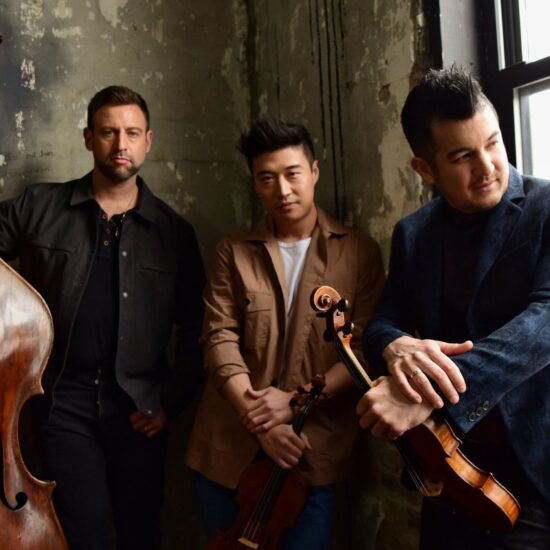
Award-winning ensemble Time for Three (TF3) defies convention and boundaries, merging classical, Americana, and singer-songwriter traditions in a singular, remarkable sound. Comprising Ranaan Meyer (double bass, vocals), Nicolas (Nick) Kendall (violin, vocals), and Charles Yang (violin, vocals), TF3 captivates audiences worldwide with their virtuosic playing and insatiable appetite for creativity that expands typical perceptions of a string trio.
In addition to the SLSO, TF3 appears this season with the Philadelphia and Louisville orchestras. Their repertoire includes their newest commissioned concerto by Mason Bates, which received its premiere at Arizona Musicfest, and has since been performed with the San Francisco Symphony and Philadelphia Orchestra. TF3 has also embarked on Emily—No Prisoner Be, a project with mezzo-soprano Joyce DiDonato. Written by Kevin Puts and inspired by the poetry of Emily Dickinson, Emily was first performed at the Bregenz Festival, received its New York premiere at Carnegie Hall in February, and has since been recorded.
TF3 won a Grammy for their album with the Philadelphia Orchestra, Letters for the Future, featuring works by Puts and Jennifer Higdon. TF3 has also collaborated with Ben Folds, Natasha Bedingfield, Branford Marsalis, Joshua Bell, Jennifer Higdon, Chris Brubeck, William Bolcom, and Arlo Guthrie. Their concert special, Time for Three in Concert, was produced by PBS and earned them an Emmy. Time for Three’s creative boundary pushing, commitment to the next generation of musicians, and pursuit of musical excellence has established them as one of the most exceptional groups on the scene today.