Mahler’s Fifth (April 10-12, 2026)
Program
April 10-12, 2026
- Stéphane Denève, conductor
- Hilary Hahn, violin
- Seth Parker Woods, cello
Carlos Simon (b. 1986)
- Double Concerto Suite (SLSO co-commission)
- I. Spritely
- II. Slow and heavy
- III. Moving with glow
- IV. Soulfully, freely –
- V. With haste – Cadenza – As before
Hilary Hahn, violin
Seth Parker Woods, cello
Intermission
Gustav Mahler (1860–1911)
- Symphony No. 5 in C-sharp minor
- PART I
- Trauermarsch (In gemessenem Schritt. Streng. Wie ein Kondukt)
- [Funeral march (With measured pace, stern, like a funeral procession)]
- Stürmisch bewegt. Mit grösster Vehemenz
- [Stormy, with utmost vehemence]
- PART II
- Scherzo (Kräftig, nicht zu schnell)
- [Strong, not too fast]
- PART III
- Adagietto (Sehr langsam)
- [Very slow]
- Rondo–Finale (Allegro)
Double Concerto Suite
Carlos Simon
Born 1986, Washington, DC
A double concerto is a special treat. The most famous is “the Brahms Double” for violin and cello. Looking to the 18th century, there are works such as Johann Sebastian Bach’s Double Violin Concerto (BWV 1043). Other well-known examples fly under the radar without the “double concerto” label: Mozart’s much-loved Sinfonia concertante for violin and viola, or Richard Strauss’ tone poem Don Quixote, which features solo cello and viola as characters in the drama.
Labels are important, and Carlos Simon’s new work carries an unusual one, almost without precedent: Double Concerto Suite. It combines the dynamic of a double concerto—two soloists interacting with each other and with the orchestra—with the multi-movement structure found in Baroque dance suites. In fact, much of this work’s lineage can be traced to the 18th century, even though Simon’s musical language is firmly in the present.
As Simon explains, the Double Concerto Suite has been inspired by a wide range of genres, from Baroque forms to the Delta blues. In the extended second movement, for example, listen for the heavy tread of cellos and double basses as they outline a repeating “passacaglia” bass melody, providing a foundation for the spinning lines of the solo cello, featured instruments from the orchestra, and (eventually!) the solo violin. Elsewhere you might detect Baroque dance rhythms such as the gavotte, but with neoclassical echoes (think Stravinsky in America) as in the “spritely” opening movement.
Simon hopes this work will allow the musicians “to express themselves through a variety of orchestral colors and musical styles.” And in the fourth movement, marked “Soulfully, freely,” symphonic instruments evoke not just the melodic and harmonic gestures of the Blues, but its colors—you’ll look in vain for a slide guitar or a Hammond organ on the stage, but their vibe is unmistakable.
You’ll also look in vain for any kind of programmatic concept—this is no “Don Quixote.” In this respect, the Double Concerto Suite is a first for Simon. Previous orchestral works of his have found inspiration in ideas as diverse as a Beethoven notebook entry, the Underground Railroad, and even urban graffiti. Now, he writes, “for the first time in my compositional career, I have decided to write a piece that allows listeners to assign their own meaning and understanding of the work. It is truly absolute music—that is, music for music’s sake.”
Yvonne Frindle © 2026
About the composer
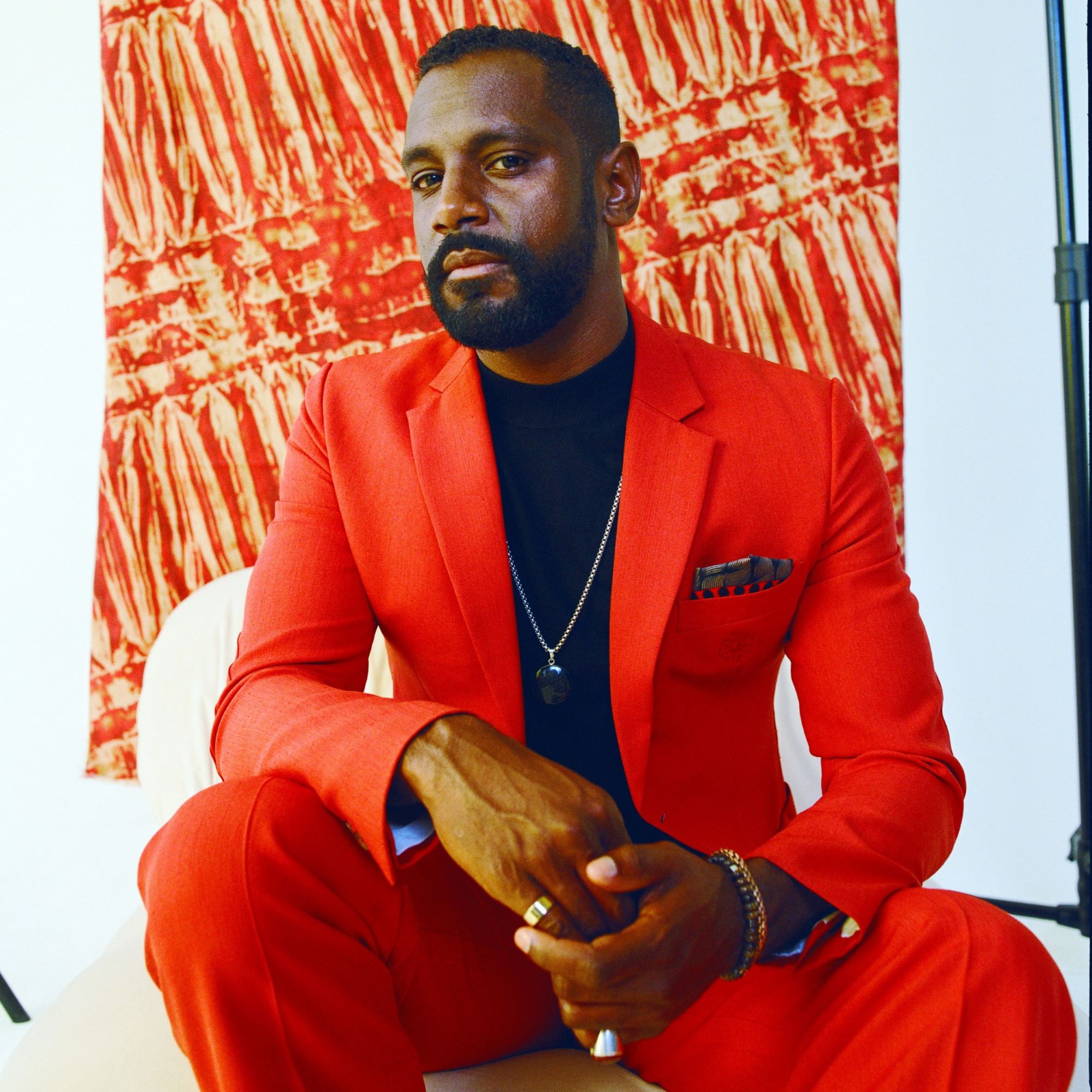
Having grown up in Atlanta, with a long lineage of preachers to inspire him, Carlos Simon offers living proof that a well-composed song can be as powerful as a sermon. As he once told The Washington Post, “Music is my pulpit. That’s where I preach.” His music ranges from concert works for large and small ensembles to film scores, drawing on the influence of jazz, gospel, and neo-romanticism, as well as liturgical texts, art, and poetry.
In 2021, Simon was named Composer in Residence for the John F. Kennedy Center for the Performing Arts, a role that has been extended through the 2026/27 season. He also holds the inaugural Composer Chair of the Boston Symphony Orchestra. His work as a curator includes Coltrane: Legacy for Orchestra (performed by the SLSO in February 2026), commissioned by the Toronto Symphony Orchestra and the San Francisco Conservatory of Music in partnership with the Coltrane Estate. He has also been commissioned by the Los Angeles Philharmonic, San Diego Symphony, Washington National Opera (with Mo Willems), New York Philharmonic and Bravo! Vail, Minnesota Orchestra, American Ballet Theatre, Detroit Symphony Orchestra, Jacksonville Symphony Orchestra, Cincinnati Pops Orchestra, Carnegie Hall for the National Youth Orchestra of the USA, and the BBC Symphony Orchestra (Last Night of the Proms).
In addition to the first performances of his new Double Concerto Suite, the 2025/26 season features premieres of Lamentations for String Orchestra and his soundtrack for The Unspoken Elegance of Stillness, as well as performances of his Good News Mass (Boston and Chicago symphony orchestras) and Zodiac: Symphonic Suite (New Jersey Symphony).
His discography includes Four Symphonic Works (2024), his Grammy- nominated Requiem for the Enslaved, and brea(d)th, commissioned by the Minnesota Orchestra and written in collaboration with Marc Bamuthi Joseph after the murder of George Floyd as a direct response to America’s unfulfilled promises and history of systemic oppression against Black Americans.
Carlos Simon is a graduate of Georgia State University and Morehouse College, and holds a doctorate from the University of Michigan. He currently serves as Associate Professor at Georgetown University.
| First performance | March 12, 2026, Gianandrea Noseda conducting the National Symphony Orchestra with soloists Ying Fu (violin) and Raymond Tsai (cello) |
| First SLSO performance | These concerts |
| Instrumentation | solo violin and cello; 2 flutes, piccolo, 2 oboes, 2 clarinets, 2 bassoons, 4 horns, 3 trumpets, 3 trombones, tuba, timpani, percussion, harp, strings |
| Approximate duration | 30 minutes |
Fifth Symphony
Gustav Mahler
Born 1860, Kaliště, Bohemia
Died 1911, Vienna, Austria
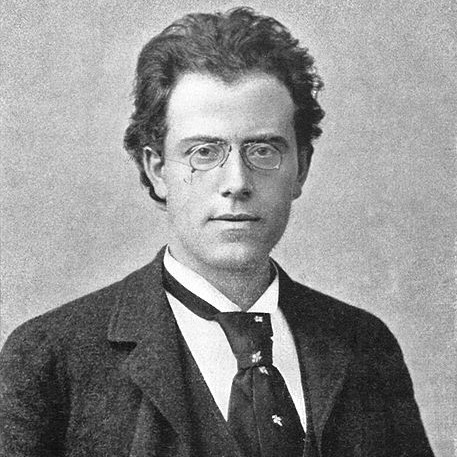
“Oh, heavens, what are they to make of this, this chaos in which new worlds are forever being engendered only to crumble in ruin the moment after? What are they to say to this primeval music, this foaming, roaring, raging sea of sound, to these dancing stars, to these breathtaking, iridescent, and flashing breakers?”
Those words, which Mahler wrote to his wife, Alma, from Cologne on the eve of the Fifth Symphony’s premiere in October 1904, might be dismissed as poetic hyperbole had they been written by any other composer. But to Mahler, a symphony truly was a fantastic and protean universe of changing moods, colors, and emotions. It was, as he once declared, a world in itself, a mirror of all of life. It was also the vessel into which he poured his personal joys and sorrows, his visions and dreads, and in the Fifth Symphony his imagination filled it to overflowing.
The five movements of this symphony are arranged to form three parts. The center panel of this triptych is a tremendous scherzo. Flanking on either side are pairs of movements that are thematically and emotionally linked. The first movement, which the composer called Funeral March, opens with a harrowing trumpet call. Mahler then sets forth two themes: the first, a lugubrious processional in the strings; the second, a brief and more hopeful idea introduced by the woodwinds. He also expands the movement with two seemingly extraneous interludes interpolated into the march. The first of these two contrasting episodes gives us the demonic Mahler, and the specter of doom raised by the trumpet call takes on a macabre aspect. The funeral music of the opening returns only to be interrupted by a second interlude, this time yearning and lyrical. The opening trumpet call returns to end the movement, its final tone echoed by a lone flute.
The second movement develops these and other thematic ideas in a vein of struggle. Fierce clashes suggestive of Tchaikovsky alternate with gentler passages in which the cellos play an important role. At one point, we also hear a stirring chorale. In addition, Mahler refers to another famous Fifth Symphony—Beethoven’s, whose celebrated four-note motto is heard in woodwind figures that accompany the main melody.
The Scherzo, which forms the capstone of the symphony’s great sonic arch, combines the elegance of waltz music with impressive contrapuntal writing. As a genre, the scherzo was once considered a brief interlude between more substantial proceedings, here it has assumed a place of central position, capable of a great range of expression. Indeed it must, for its purpose within the symphony’s dramatic framework is to counter the nihilistic tone of the opening movements.
The ensuing Adagietto is one of the most delicate movements in all of Mahler’s symphonies. Its dream-like character is emphasized by its scoring for strings and harp alone. The music begins quietly, almost hesitantly, with nascent phrases that grow in what seems an almost organic way into long-breathed melodies. Mahler leads these to ever more expressive heights, achieving a sense of aching poignancy before allowing the movement to subside to a gentle conclusion.
We are awakened from this dream by rustic woodwind calls that usher in the Rondo–Finale. This movement finds Mahler at his most exuberant. Its principal themes are developed in brilliant fugal episodes, but that is not all. Melodies appear from the Adagietto, from some of Mahler’s own songs, even from the works of other composers (Wagner’s opera Die Meistersinger von Nürnberg is affectionately quoted). These interpolations culminate with a full-voiced return of the chorale of the second movement. Mahler closes the symphony with a coda passage that combines, in a brilliant riot of counterpoint, themes heard during the course of the movement.
Paul Schiavo © 2009
| First performance | October 18, 1904, by the Gürzenich Orchestra Cologne, conducted by the composer |
| First SLSO performance | December 9, 1966, Eleazar De Carvalho conducting |
| Most recent SLSO performance | January 23, 2016, David Robertson conducting |
| Instrumentation | 4 flutes (doubling piccolos), 3 oboes (one doubling English horn), 3 clarinets (doubling E-flat clarinet and bass clarinet), 3 bassoons (one doubling contrabassoon), 6 horns, 4 trumpets, 3 trombones, tuba, timpani, percussion, harp, strings |
| Approximate duration | 68 minutes |
Artists
Hilary Hahn
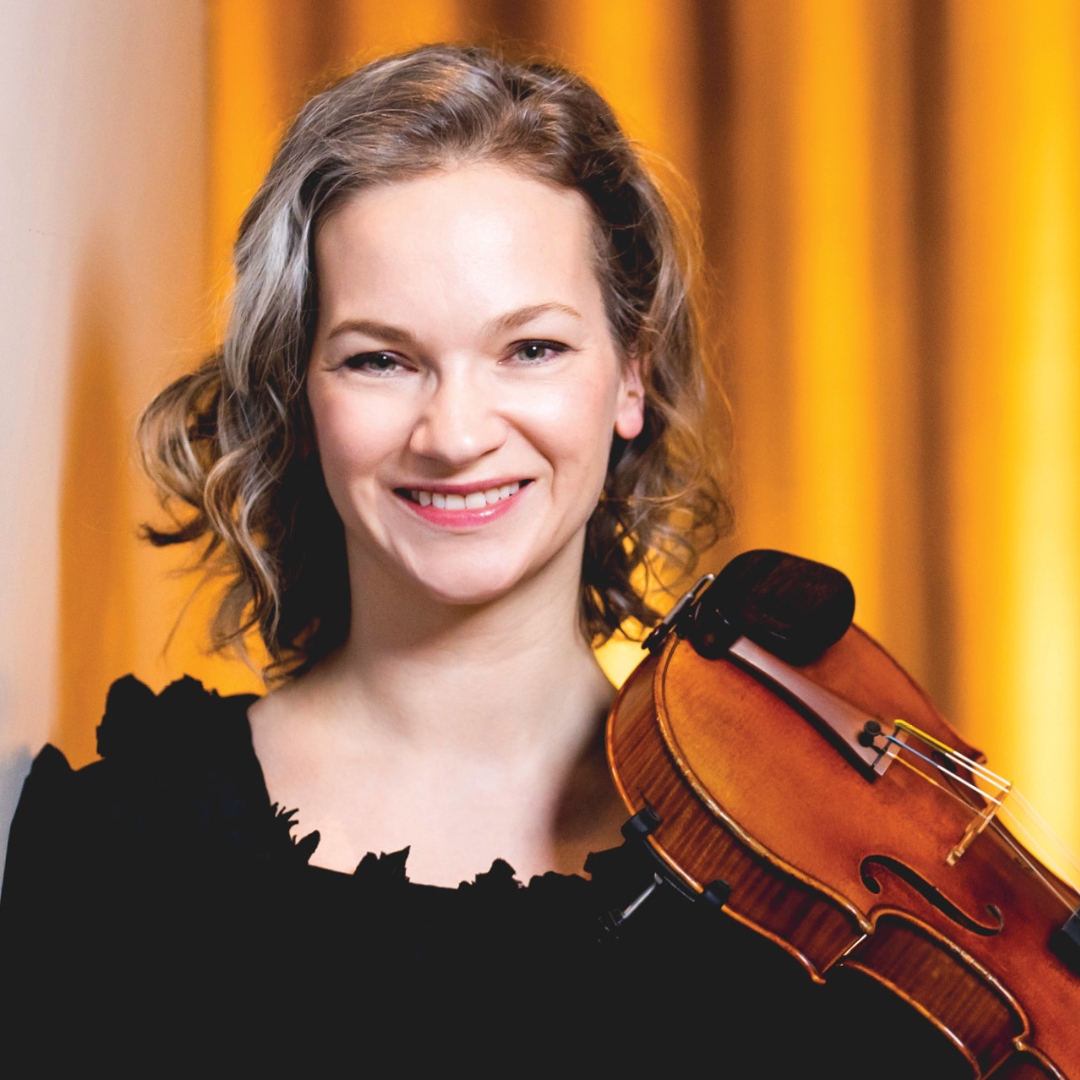
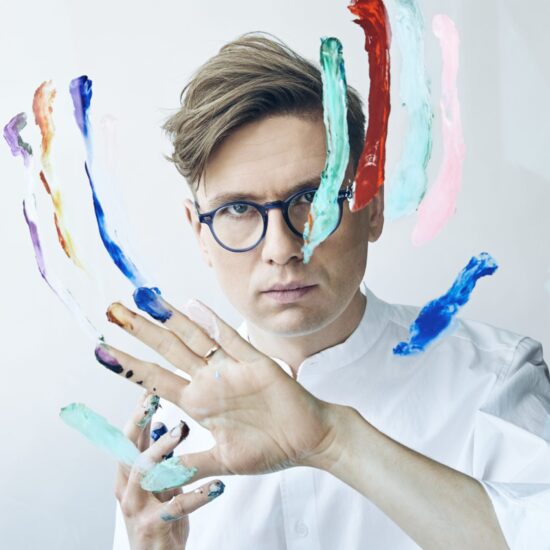
Three-time Grammy Award-winning violinist Hilary Hahn melds expressive musicality and technical expertise with a repertoire guided by artistic curiosity. She is known for performing music ranging from solo Bach and the classical repertoire to today’s major composers, and she has personally commissioned works by more than 40 living composers. She is a member of the Juilliard School’s string faculty, having previously served as visiting professor at the Royal Academy of Music and artist in residence at the Chicago Symphony Orchestra and the New York Philharmonic.
Her wide repertoire is reflected in her 23 feature recordings, which have all opened in the Billboard top ten. Recent releases include Night After Night, a collection of James Newton Howard’s scores for the films of M. Night Shyamalan, and a Gramophone Award-winning recording of Eugène Ysaÿe’s six sonatas for solo violin. Her #100DaysOfPractice project, launched in 2017, has transformed practice into a communal celebration of artistic development with nearly one million posts across platforms. Her BYOBaby concerts create a welcoming space for families of infant children to enjoy classical music together.
Hilary Hahn studied at the Curtis Institute of Music, and holds honorary doctorates from Curtis, Middlebury College, and Ball State University. In recent seasons, she has received the Avery Fisher Prize, was named Musical America’s Artist of the Year, and received the Herbert von Karajan and Glasshütte Original Music Festival awards.
Seth Parker Woods
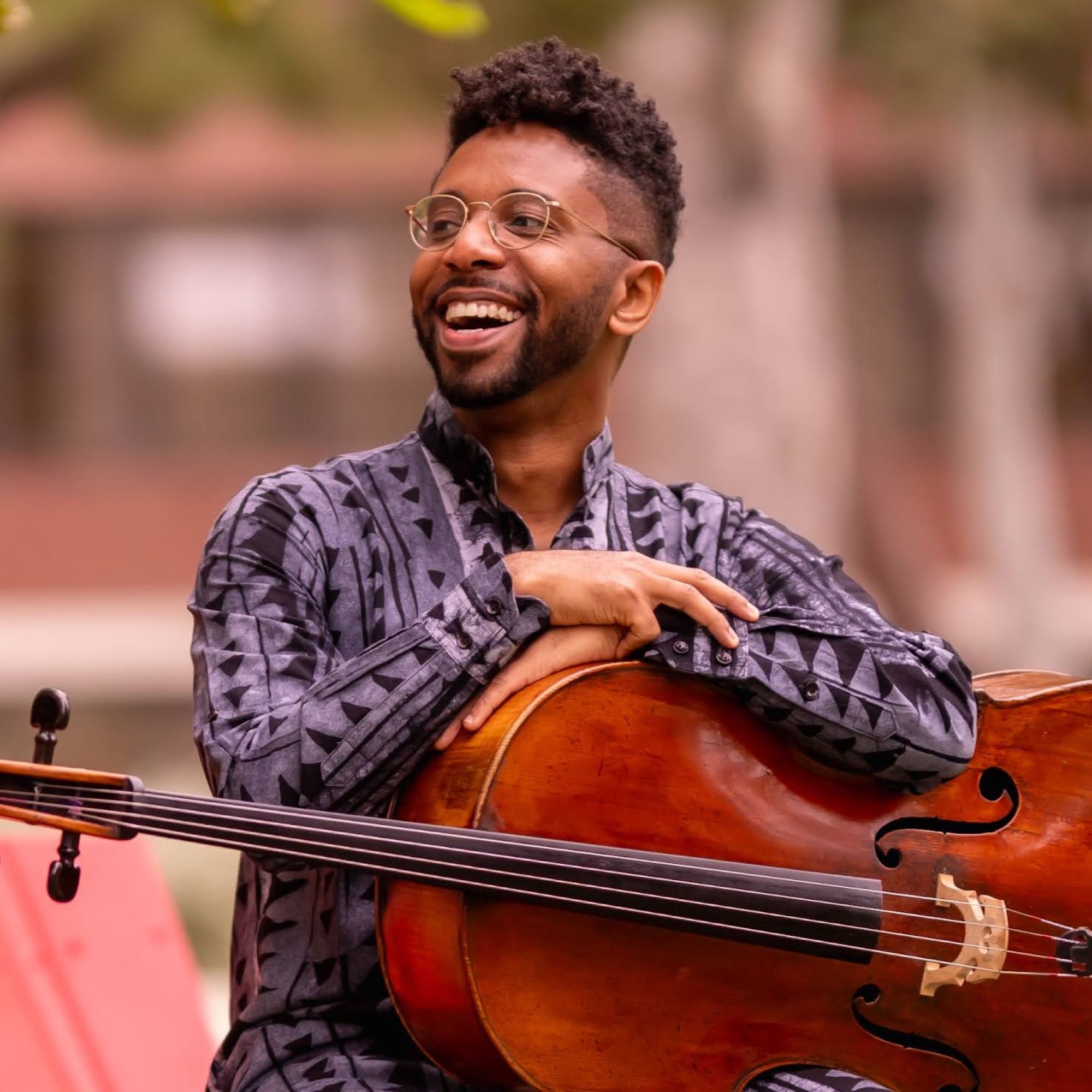
In addition to making his SLSO debut in these concerts, the 2025/26 season has held several high-profile engagements for Houston-born cellist Seth Parker Woods, including his solo debut at the Barbican Centre, London; the South American premiere of Nathalie Joachim’s cello concerto, Had to Be, with the São Paulo State Symphony Orchestra in Brazil; performances in Hamburg with Ensemble Resonanz in his Elbphilharmonie debut; and a national tour in a new trio with soprano Julia Bullock and pianist Conor Hanick. This follows a notable 2024/25 season in which he made his New York Philharmonic and Los Angeles Philharmonic debuts, and acclaimed performances of his autobiographical tour de force Difficult Grace following its premiere at 92NY in 2022 and subsequent Grammy-nominated recording.
A champion of contemporary composers, he has premiered numerous concertos written specifically for him. These include Tyshawn Sorey’s For Roscoe Mitchell and the American premiere of Rebecca Saunders’ Ire (both with the Seattle Symphony), Joachim’s Had To Be (Spoleto Festival USA, New York Philharmonic, Orchestre Métropolitain Montréal, and Chautauqua Symphony), and Julia Adolphe’s Chrysalis (Los Angeles Philharmonic).
He holds degrees from Brooklyn College and the Musik Akademie der Stadt Basel, as well as a PhD from the University of Huddersfield. He serves on the faculty of the Thornton School of Music at the University of Southern California where he is the Robert Mann Chair in Strings and Chamber Music, and he has taught at the Music Academy of the West.
Seth Parker Woods is also recognized for his distinctive personal style, having appeared on Best Dressed lists in Variety, Texas Monthly, and The Orange County Register.