Pictures at an Exhibition (November 28–29, 2026)
Program
November 28–29, 2026
- John Storgårds, conductor
- Himari, violin
Sergei Rachmaninoff (1873–1943)
- The Isle of the Dead, Op. 29 (20 minutes)
Alexander Glazunov (1865–1936)
- Concerto in A minor, Op. 82, for violin and orchestra (21 minutes)
- Moderato
- Andante
- Allegro
Himari, violin
Intermission
Modest Mussorgsky (1839–1881)
Orchestrated by Maurice Ravel
- Pictures at an Exhibition (35 minutes)
- Promenade –
- Gnomus (The Gnome) –
- Promenade –
- Il vecchio castello (The Old Castle) –
- Promenade –
- Tuileries –
- Bydlo (The Polish Oxcart) –
- Promenade –
- Ballet of the Unhatched Chicks –
- Samuel Goldenberg and Schmuÿle –
- The Market at Limoges –
- Sepulcrum romanum (Catacombs) –
- Cum mortuis in lingua mortua
- (With the Dead in a Dead Language) –
- The Hut on Fowl’s Legs (Baba-Yaga) –
- The Great Gate at Kyiv
A Lyrical Tour
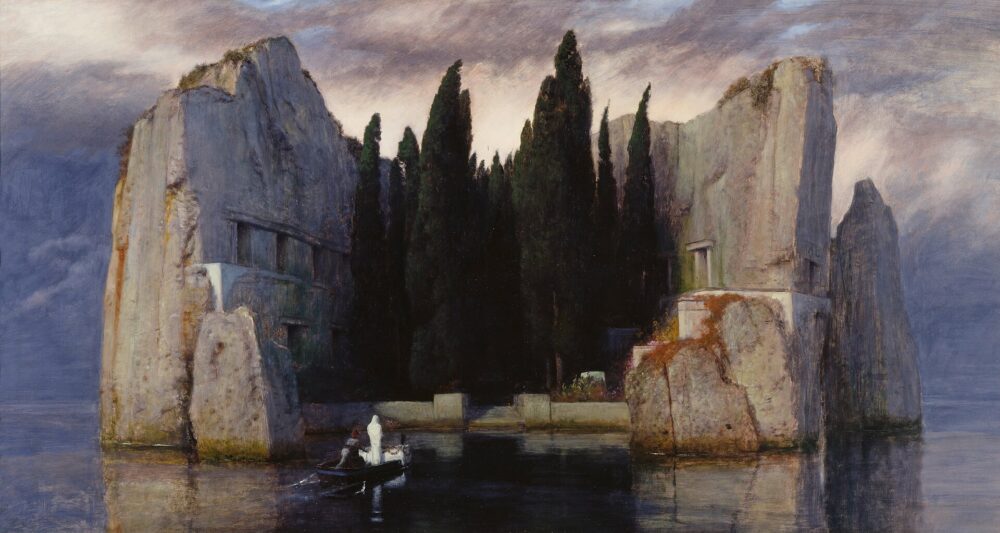
Conductor John Storgårds’ most recent visit to Powell Hall concluded with a memorable performance of Dmitri Shostakovich’s playful-yet-pessimistic Symphony No. 15. Storgårds opens this program with an unequivocally dark, moody work by another great Russian composer, Sergei Rachmaninoff. Inspired by Arnold Böcklin’s ominous painting of the same name, Rachmaninoff’s Isle of the Dead is cloaked with intrigue and eerie, Gothic grandeur. Our journey reaches its destination with a literal stroll around an art gallery, as depicted in Modest Mussorgsky’s Pictures at an Exhibition, a tribute to the composer’s friend that is brought vividly and emotionally to life by Maurice Ravel’s orchestration. Between these two works inspired by visual art, we have an opportunity to witness a rising musical star; the 15-year-old prodigy Himari, who makes her SLSO debut performing Alexander Glazunov’s dazzling Violin Concerto.
The Isle of the Dead
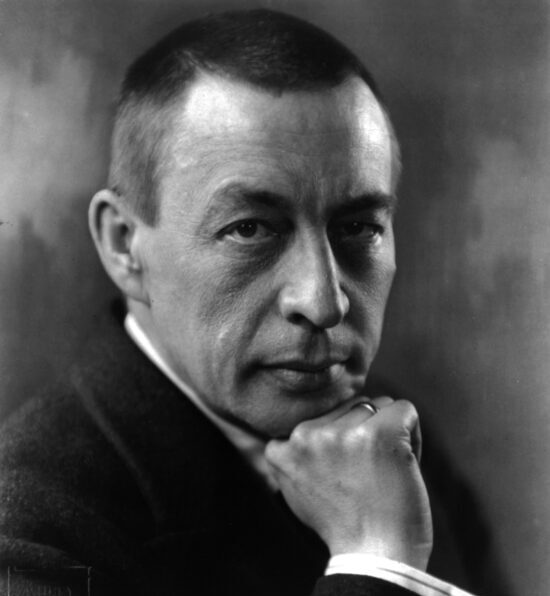
Sergei Rachmaninoff
Born 1873, Semyonovo, Russia
Died 1943, Beverly Hills, California
Böcklin’s Painting
A small, rocky island rises from the darkness of an eerily calm sea. At its center stands a grove of tall, slender trees that seem to consume the light. The isle is deserted yet bears the marks of man; a row of rectangular vaults is hewn from the rock, and a wall with a narrow entrance guards the small harbor. A rowboat approaches. In its bow is a coffin, over which stands a figure draped all in white, eyes fixed ahead. The oarsman, dressed in black, propels the vessel gently forward toward the landing.
This image, depicted in Swiss artist Arnold Böcklin’s painting Isle of the Dead, resonated with early 20th-century figures including Sigmund Freud, V.I. Lenin, and Sergei Rachmaninoff. Rachmaninoff, who Igor Stravinsky described as “six feet, two inches of Russian gloom,” had a penchant for all things sinister and ominous, and was immediately inspired. He completed his symphonic poem of the same name in 1909.
The Music
Rachmaninoff was fascinated—obsessed, even—with the Dies irae motif, which has been used in funereal music since the days of Gregorian chant. It pervades The Isle of the Dead, forming the thematic basis of all the central motifs.
The music begins in a gentle 5/8 time, illustrating the boat’s slow approach to the island, underscored with ominous, rumbling bass. The music slowly gains momentum and volume, building to a menacing climax about halfway through. A new, more uplifting theme now emerges in the upper strings and woodwinds. Rachmaninoff explained that this theme represents life, and its interaction with the Dies irae music illustrates the cyclical nature of life and death. The “life” theme builds, struggling to a yearning climax of its own, but the Dies irae comes crashing back, drowning the new theme and propelling the work to its hushed, mournful conclusion.
Adapted from a note by Jay Goodwin © 2011
| First performance | April 18, 1909, the composer conducting the Moscow Philharmonic Orchestra |
| First SLSO performance | February 24, 1911, Max Zach conducting |
| Most recent SLSO performance | February 2, 2019, Matthias Pintscher conducting |
| Instrumentation | 3 flutes (one doubling piccolo), 2 oboes, English horn, 2 clarinets, bass clarinet, 2 bassoons, contrabassoon, 6 horns, 3 trumpets, 3 trombones, tuba, timpani, percussion, harp, strings |
Violin Concerto
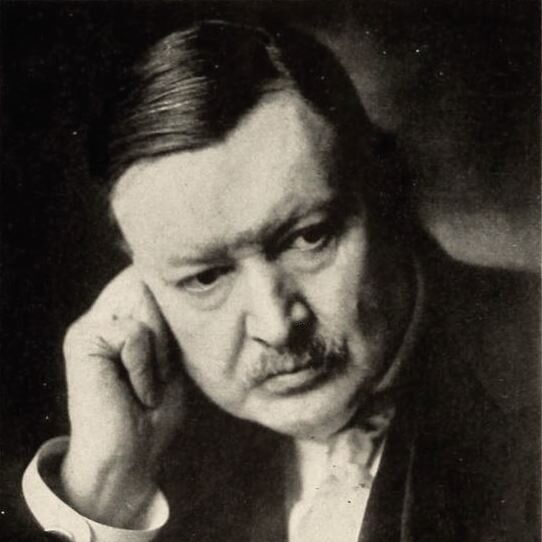
Alexander Glazunov
Born 1865, St. Petersburg, Russia
Died 1936, Paris, France
Traditionalists and Nationalists
During the second half of the 19th century, Russian music was divided into two distinct camps. More conservative composers, typified by Anton Rubinstein, looked to Western Europe for models of compositional form and style, such as the symphony, the sonata, and the concerto.
Opposing this group was a band of nationalist composers that came to be known as the moguchaya kuchka, a term best translated as “The Mighty Handful.” Led by Mily Balakirev and, later, by Nikolai Rimsky-Korsakov, these musicians brought a strongly Russian character to their scores. They referred to folk melodies in their themes, frequently alluded to Russian history and lore, and developed a more vibrant and powerful style of orchestration than any cultivated in Western Europe.
Playing Both Sides
Although these schools each had zealous partisans, some composers drew on both movements for influence. Tchaikovsky did this with considerable success, as did Alexander Glazunov, whose 1904 Violin Concerto remains his most popular work.
Glazunov neatly straddled the traditionalist and nationalist camps. From the latter group, specifically his teacher Rimsky-Korsakov, he adopted a distinctly Slavic approach to melody, informed by the inflections of Russian folk song. However, he also accepted the traditionalists’ faith in the classical forms of symphony and concerto. Glazunov’s skilled handling of these forms and thoughtful development of his themes are indebted above all to Felix Mendelssohn and Johannes Brahms, exemplars of the Austro-German “central tradition” disdained by the kuchka.
What to Listen For
– Mendelssohn’s influence is especially evident in Glazunov’s Violin Concerto. Following the example of Mendelssohn’s celebrated violin concerto, Glazunov abandons the traditional orchestral opening. Instead, the violin presents a soulful melody over a quiet, restless accompaniment.
– The Andante section introduces a tender new melody and culminates in a demanding cadenza for the soloist.
– The finale, simultaneously martial and dance-like in tone, provides colorful music replete with harmonic passages and other brilliant instrumental effects.
Adapted from a note by Paul Schiavo © 2006
| First performance | February 15, 1905, the composer conducting at the Russian Music Society in St. Petersburg, Leopold Auer as soloist |
| First SLSO performance | March 3, 1916, Max Zach conducting, Kathleen Parlow as soloist |
| Most recent SLSO performance | April 30, 2006, Asher Fisch conducting, David Halen as soloist |
| Instrumentation | solo violin; 2 flutes, piccolo, 2 oboes, 2 clarinets, 2 bassoons, 4 horns, 2 trumpets, 3 trombones, timpani, percussion, harp, strings |
Pictures at an Exhibition
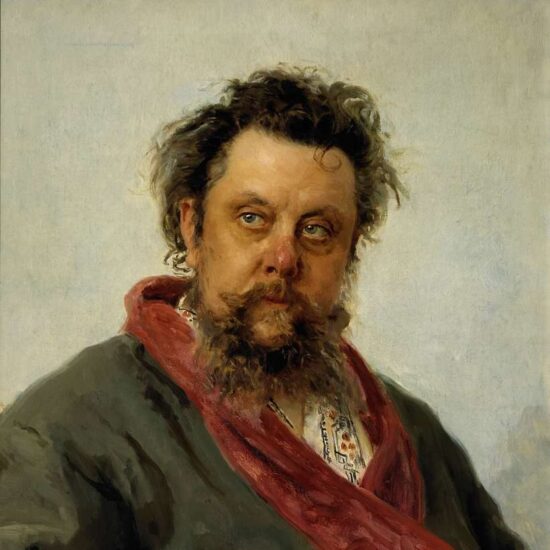
Modest Mussorgsky
Born 1839, Karevo, Russia
Died 1981, St. Petersburg, Russia
A Musical Tribute
In 1874, Modest Mussorgsky was immersed in work on his huge opera Khovanshchina when he received word of a memorial exhibit of pictures by his close friend, the artist and architect Victor Hartmann, who had died a year earlier. After visiting the gallery, the composer resolved to pay his own tribute by writing a set of piano pieces inspired by the drawings. Mussorgsky worked with remarkable speed—“sounds and ideas fill the air, and I can barely scribble them down fast enough,” he wrote— completing the lengthy score on June 22.
The finished work represented ten of Hartmann’s images, a format which might have made for a loose suite of unrelated movements. But Mussorgsky prefaced his musical pictures with a “Promenade” in which he imagined himself “roving through the exhibition—now leisurely, now briskly—in order to come close to a picture that has attracted [my] attention.” The Promenade unifies the composition, providing an interlude between movements and also appearing in the “Catacombs” and “The Great Gate at Kyiv” sections.
Ravel’s Inspired Orchestration
Pictures at an Exhibition was performed infrequently during Mussorgsky’s lifetime. But in 1922, conductor Serge Koussevitsky commissioned the French composer Maurice Ravel to orchestrate the music. Ravel’s scoring was inspired even when unorthodox: the presentation of the mournful melody of “The Old Castle” by the saxophone is as effective as it is unexpected; the folk tune heard in “Bydlo” (whose title refers to a three-wheeled cattle cart) is both ponderous and lyrical when sung in the high register of the tuba.
The music is sufficiently suggestive that the individual “pictures” require but a little description. “Tuileries” is the famous gardens in Paris, here portrayed with children at play. “Ballet of the Unhatched Chicks” derives from Hartmann’s sketch of decor for a diversion by Marius Petipa, the renowned choreographer at the Imperial Theater in St. Petersburg. “Samuel Goldenberg and Schmuÿle” is a composite of two portraits Hartmann drew near the Warsaw ghetto. The portraits depict two Jewish men—one is rich, the other poor. To judge by Mussorgsky’s music, the men seem to be quarreling.
“Catacombs” is for a drawing Hartmann made of the famous Roman tombs. Its music continues directly into Mussorgsky’s meditation on an inscription there: “Cum mortuis in lingua mortua” (With the Dead in a Dead Language). “Baba-Yaga” is a witch familiar in Russian folklore. She lives in a dreadful hut adorned with human skulls and walks through the forest on giant chicken legs. The finale depicts Hartmann’s design for a majestic stone arch to be built over a small chapel in Kyiv; Mussorgsky imagines both the church—we hear a traditional Russian hymn and ringing bells—and the great arch sheltering it.
Adapted from a note by Paul Schiavo © 2013
| First performance | May 3, 1923, Serge Koussevitzky conducting in Paris |
| First SLSO performance | October 31, 1930, E. Fernández Arbós conducting |
| Most recent SLSO performance | October 8, 2022, Jonathon Heyward conducting |
| Instrumentation | 3 flutes (two doubling piccolo), 3 oboes (one doubling English horn), 2 clarinets, bass clarinet, 2 bassoons, contrabassoon, 4 horns, 3 trumpets, 3 trombones, tuba, timpani, percussion, 2 harps, piano, alto saxophone, strings |
Artists
John Storgårds
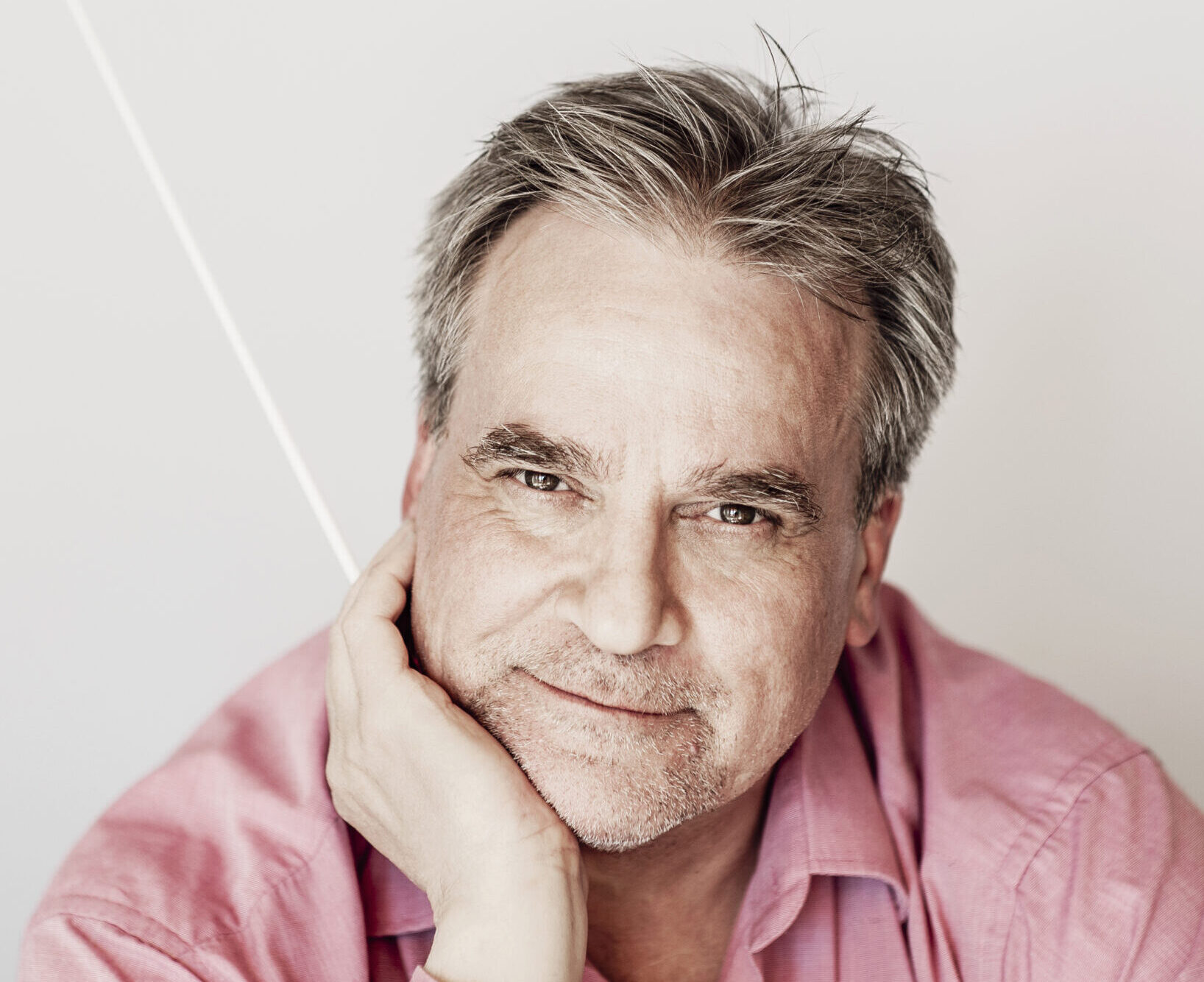
John Storgårds enjoys a dual career as a conductor and violin virtuoso, and is widely recognized for his creative flair for programming. He is the Chief Conductor of the BBC Philharmonic Orchestra and Turku Philharmonic Orchestra, and recently celebrated his 30th anniversary as the Artistic Director of the Lapland Chamber Orchestra. The 2026/27 season begins with Storgårds’ return to the BBC Proms, before he conducts his first concerts as Principal Conductor and Artistic Advisor of the Junge Deutsche Philharmonie, and as Music Director of Canada’s National Arts Centre Orchestra in Ottawa respectively. He also conducts the inaugural concerts at Turku’s new Music Centre Fuuga. As a violinist, Storgårds is an active chamber musician and recitalist who frequently incorporates solo performances into his conducting engagements. He also performs recitals internationally with his regular duo partner, Kirill Gerstein. John Storgårds’ most recent appearance with the SLSO was in December 2025, conducting works by Clara Wieck Schumann, Joseph Haydn, and Dmitri Shostakovich.
Himari
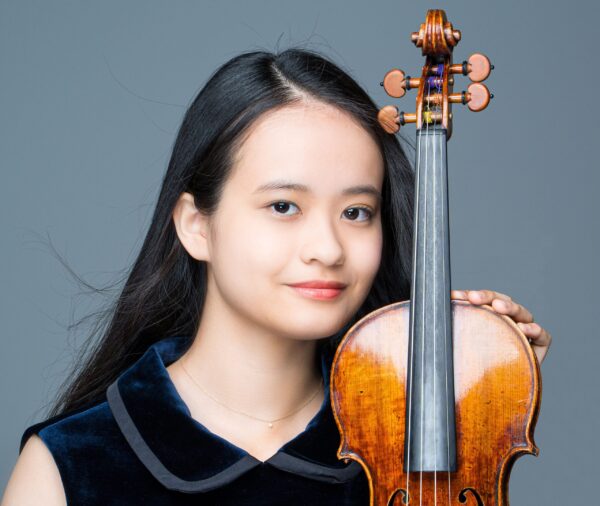
Himari made her European debut with the Berlin Philharmonic in 2025, before first-time performances with ensembles including the London Philharmonic Orchestra, Chicago Symphony Orchestra, Pittsburgh Symphony Orchestra, and the Philadelphia Orchestra. She has performed with all the major orchestras in her native Japan. The 26/27 season includes appearances with the London Symphony Orchestra, Minnesota Orchestra, Seoul Philharmonic Orchestra, and San Francisco Symphony, as well as her much-anticipated debut at Carnegie Hall with the Boston Symphony Orchestra and Andris Nelsons. She will embark on her first recital tour of the US in spring 2027, performing works by Edvard Grieg, Maurice Ravel, and Franz Schubert. Himari’s debut album was released by Decca in September 2026. She currently studies with Ida Kavafian at the Curtis Institute of Music in Philadelphia. These concerts mark Himari’s SLSO debut.